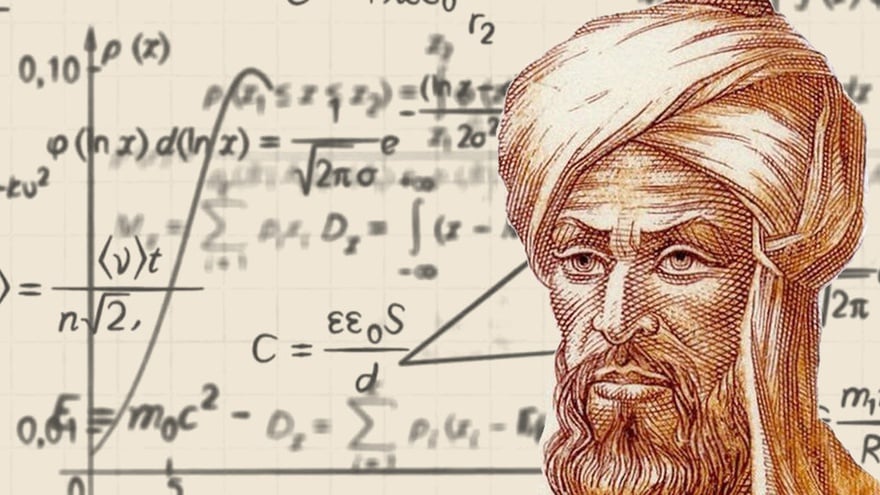
At Hiesab, we are deeply passionate about Islamic identity and heritage, particularly the Islamic Golden Age. The reason for this is that this era, founded by Harun al-Rashid (may Allah have mercy on him), was built upon precision and justice in calculating inheritances, rents, and all transactions, through which good governance is achieved. This work was profoundly inspired by the Holy Qur'an, beginning with the verses that point to precision, proportion, and measure in everything, such as the verse: (Indeed, all things We created with a proportion).﴾ (Al-Qamar: 49), and the verses that highlight the scale and the necessity of balance, such as: (And establish weight in justice and do not make deficient the balance) (Ar-Rahman: 9), as well as the verses urging the learning of calculation, such as: (It is He who made the sun a shining light and the moon a derived light and determined for it phases - that you may know the number of years and computing. Allah has not created this except in truth. He details the signs for a people who know) (Yunus: 5).
By acting upon all these recommendations mentioned in the Holy Qur'an, and by embracing the spirit of research, curiosity, inquiry, and collaboration that characterized the Islamic Golden Age, Harun al-Rashid (may Allah have mercy on him) laid the foundation stone by establishing the House of Wisdom (Bayt al-Hikma). This institution contributed to directing the general scholarly focus toward achieving precision and exactness in calculation, thereby fulfilling justice in governance and all transactions, as commanded by Allah, the Blessed and Exalted.
The work of Al-Khwarizmi (may Allah have mercy on him) was the key that led this civilization, as well as subsequent civilizations that built upon it—most notably European civilization—to advance across various sciences; for arithmetic is the key to all cosmic sciences, including medicine, engineering, and others. Al-Khwarizmi's book on Hindu numerals, known in Arabic as "Kitab al-Jam' wa-l-Tafriq bi-Hisab al-Hind" (and known in its Latin translation as Algoritmi de numero Indorum), is considered one of the most important books that revolutionized global mathematics. It served as the primary bridge for transmitting the decimal positional system and the symbol zero from Hindu culture to the Islamic world, and from there to Europe.
He is credited with studying and teaching Hindu numerals and their method of writing until the Arabs and Muslims mastered and improved their script. This resulted in the Arabic numerals (as known to Europeans), which were also called Hindu-Arabic numerals, branching into two distinct styles: Muslims in the Mashriq (Eastern Arab world) chose (۰ ۱ ۲ ۳ ٤ ٥ ٦ ٧ ۸ ۹) as numeral symbols, while Muslims in the Maghreb (North Africa and the western Arab world) chose (0 1 2 3 4 5 6 7 8 9). The latter eventually transitioned to Europe, moving from Algeria to Italy through the Italian mathematician Fibonacci, and from Andalusia to the rest of Europe.
When Al-Khwarizmi translated the Indian arithmetic in Baghdad, he presented the numbers in their initial Indian form. This common origin was transmitted to two different cultural environments within the Islamic world, and in each of them it developed independently to suit local writing materials and calligraphic styles:
-
In the Arab Levant (Baghdad, Damascus, Cairo): Indian numbers gradually evolved into 'Oriental numbers' (
۰ ۱ ۲ ۳ ٤ ٥ ٦ ٧ ۸ ۹). Her drawing was influenced by Levantine Arabic scripts, such as Naskh and Thuluth, and she relied on writing with pen and ink on paper. -
In the Maghreb and Andalusia: Indian numbers developed in a completely different way to become 'dust numbers' (
0 1 2 3 4 5 6 7 8 9). It was called 'Ghubariyya' because scholars and merchants in those regions used to conduct calculations by drawing numbers on boards covered with a thin layer of dirt or fine dust using a stylus (a sharp tool), which made straight shapes and sharp angles more practical and easier to draw than curved lines.
By combining various arithmetic concepts available to him at the time from Hindu, Greek, and Babylonian civilizations, Al-Khwarizmi (may Allah have mercy on him) succeeded in transforming the concept of mathematics and arithmetic from merely step-by-step procedures for solving specific computational problems into a comprehensive, universal system applicable to different fields and aspects of life.
His contribution was not limited to transmitting and simplifying the Hindu numeral system and the zero; rather, he crowned his genius by establishing an entirely new science through his famous book, "Al-Kitab al-Mukhtasar fi Hisab al-Jabr wa-l-Muqabala" (The Compendious Book on Calculation by Completion and Balancing). In this unique treatise, Al-Khwarizmi presented the "algebraic method" for the first time as a distinct science independent of geometry and traditional arithmetic, introducing terms and concepts that are still used globally today (such as the word "Algebra", derived from Al-Jabr). Through it, he formulated systematic solutions for first and second-degree equations and laid the foundations of "Algorithms" (derived from his name), which form the bedrock of modern programming sciences, making him the intellectual bridge over which humanity crossed into the scientific and technological Renaissance.
Al-Khwarizmi (may Allah have mercy on him) left a monumental legacy in the science of arithmetic during the Abbasid Caliphate, paving the way for all the scholars who followed him, such as Abu Kamil in Egypt, Al-Khayyam, and Al-Biruni. The Umayyads later carried this legacy to Andalusia until it reached Europe, serving as one of the core secrets and keys of the European Renaissance. Unfortunately, however, some European scholars copied and translated these books without attributing them to their original authors—a common practice during the European Renaissance. Examples include Fibonacci, who drew heavily from the works of Al-Khwarizmi and Abu Kamil (may Allah have mercy on them) without giving them credit, as did the Italian mathematician Luca Pacioli. Europeans then continued to build upon these works until they arrived at advanced mathematical concepts.
Curiously, some European mathematicians, such as François Viète—who merged algebra with geometric shapes in imitation of Al-Khwarizmi—described the Arabs and Muslims as barbarians, claiming they had corrupted the concepts of algebra. This reflected an unjustified animosity toward the Islamic civilization that had formed the actual foundation of algebra and geometric applications during that era, including the very principles Viète himself learned. Viète also attempted to change the name "Algebra" to "Analytic Art" to strip it of its Arabic origin, but this attempt failed. Many scholars in Europe later acknowledged the virtue of Al-Khwarizmi and his book on algebra, to the extent that he became known among them as the spiritual father of algebra and mathematics, and his terms permanently entered their linguistic dictionaries, such as the words "Algebra" and "Algorithms".
Development continued in Europe until Leonhard Euler built upon these contributions, arriving at the mathematical expressions we recognize today. Later, in 1902, David Hilbert succeeded in making these expressions entirely abstract, which are the formulations mathematicians use today to establish mathematical proofs.
As a consequence of successive wars, Al-Khwarizmi's original Arabic manuscript was lost, and no Arabic edition of the book was published until 1931, and then in 1937—more than a thousand years after its composition. This happened when the two Egyptian scholars, Ali Mostafa Mosharafa and Muhammad Mussa Ahmad, discovered the only surviving manuscript copy in the Oxford Library in Britain. This copy had been transcribed roughly five hundred years after the passing of Al-Khwarizmi (may Allah have mercy on him) and is believed to have been brought from Egypt.
Despite the outstanding efforts of these two Egyptian scholars, they did not succeed in framing an appropriate introduction for the book. They focused their praise on Al-Khwarizmi's work strictly within the context of Egyptian civilization, despite Al-Khwarizmi being distant from it in both time and place. This approach stood entirely outside the true context that Al-Khwarizmi himself set out in his text. In his own introduction, he clearly demonstrated that the ultimate objective of the science of algebra and balancing is to establish justice in transactions, trade, and inheritances in accordance with the rulings of Islamic Sharia.
To demonstrate exactly what Al-Khwarizmi sought to achieve, we present the full introduction of his book here:
This is the book authored by Muhammad ibn Musa al-Khwarizmi, which he commenced by saying:
Praise be to Allah for His blessings, with such praise as is due to Him from among His laudations, whereby the fulfillment of what He has made obligatory upon those of His creation who worship Him earns the name of gratitude and merits an increase—acknowledging His Lordship, humbling oneself before His might, and bowing in reverence to His majesty. He sent Muhammad (may Allah bless him and his family and grant them peace) with the prophecy after a cessation of messengers, as a light of truth and a guide from straying; through him, He gave sight after blindness, delivered from ruin, multiplied after scarcity, and united after division.
Blessed be Allah our Lord, exalted be His majesty, sanctified be His names, and there is no deity besides Him. May the blessings of Allah be upon Muhammad the Prophet and his family and grant them peace. Scholars of past ages and bygone nations have never ceased to write books on the various branches of science and aspects of wisdom they composed, looking out for those who would come after them, seeking reward from Allah according to their capacity, and hoping that a share of that reward, treasure, and remembrance would reach them, leaving for them a truthful legacy that makes light of the heavy burdens they undertook and the hardships they bore upon themselves in uncovering the secrets and complexities of science. A scholar is either a man who preceded to what was not discovered before him and bequeathed it to those after him; or a man who explained what the predecessors left behind of what was locked away, thereby clarifying its path, easing its course, and bringing its grasp closer; or a man who found a defect in some books and mended its state, repaired its structure, and maintained a good opinion of its author, without refuting him or boasting of his own deeds.
I have been encouraged by the favor Allah bestowed upon the Imam Al-Ma'mun, Commander of the Faithful—alongside the Caliphate whose inheritance He secured for him, with whose garment He honored him, and with whose adornment He beautified him—in his love for literature, his bringing its people close, his extending his protection over them, and his assistance to them in clarifying what was ambiguous and smoothing what was difficult. This encouraged me to compose a concise book on Algebra and Balancing, encompassing the subtle and grand aspects of arithmetic, due to the vital necessity people have for it regarding their inheritances, their legacies, their partitions, their judgments, their trade, and in all that they transact among themselves concerning the measuring of lands, the digging of rivers, geometry, and other various aspects and arts. I offer this with a good intention, hoping that the people of literature will accord it its rightful place by virtue of the blessings, grand favors, and beautiful trials Allah has entrusted to them. Through Allah is my success in this and other matters; upon Him I rely, and He is the Lord of the Magnificent Throne. May the blessings of Allah be upon all the prophets and messengers.
We conclude with this video, which is one of the best compilations analyzing the works of Al-Khwarizmi and demonstrating their vital importance to European civilization:
References
- The Brief Book on the Calculation of Algebra and Al-Muqabala
- Al-Khwarizmi: The 9th-Century Scholar Behind Modern Technological Advancements
Similar Topics
No similar topics.
Login to be able to share, comment, and see other comments.